Football pitch markings explained
 By the Find My Football Pitch team·
Updated ·
5 min read
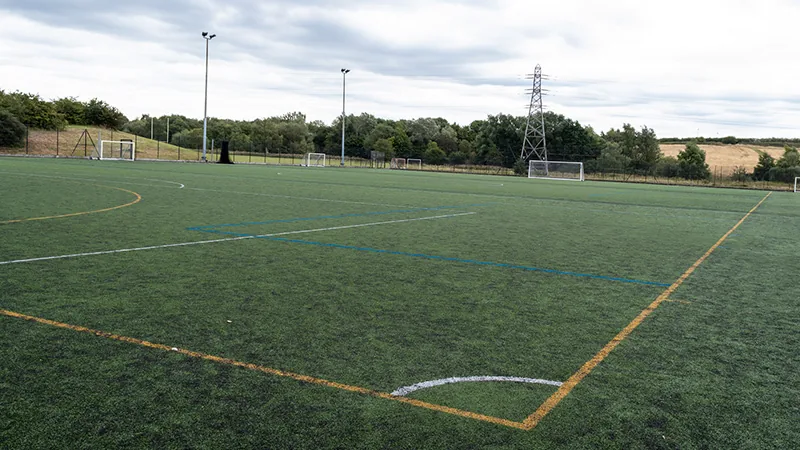
Every full-size pitch carries the same set of lines, arcs and spots, and each one has a job in the Laws of the Game. On 3G pitches you will also see extra lines in other colours. This guide goes through each marking, its size and what it is for.
The short answer
A football pitch has touchlines along the sides, goal lines at the ends, a halfway line with a centre mark and a 9.15 m centre circle, a penalty area and goal area at each end, a penalty mark 11 m from goal with an arc outside the box, and a 1 m corner arc at each corner. All lines are the same width, no more than 12 cm, and they count as part of the area they mark.
The boundary lines
The two long lines are the touchlines and the two short ones are the goal lines. Together they make the field of play. On a full-size pitch the touchlines are 90 to 120 m long and the goal lines 45 to 90 m, with narrower limits for international matches. The touchlines must be longer than the goal lines. The full size table is in football pitch dimensions.
Under Law 1 all lines must be the same width, no more than 12 cm (5 inches), and the goal line between the posts must be the same width as the posts and crossbar. Measurements are taken from the outside of the lines.
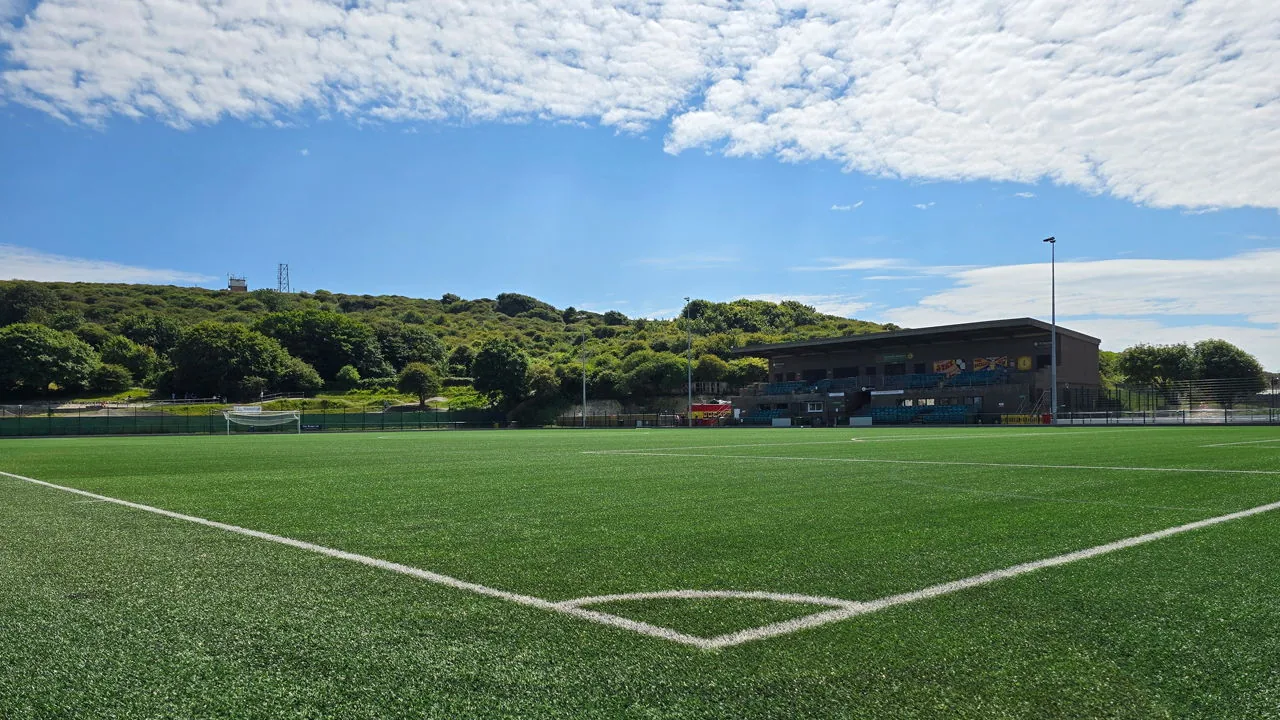
Halfway line and centre circle
The halfway line joins the midpoints of the two touchlines and splits the pitch into two halves. A centre mark sits in the middle of it, and the centre circle is drawn round it with a radius of 9.15 m (10 yards).
At kick-off every player must be in their own half, and the team not kicking off must stay outside the circle until the ball is in play. The halfway line also matters for offside: you cannot be offside in your own half. More on both in the centre circle and halfway line.
The markings at each end
| Marking | Size | What it is for |
|---|---|---|
| Goal area (six-yard box) | 5.5 m from each post, 5.5 m deep | Goal kicks are taken from anywhere inside it |
| Penalty area (18-yard box) | 16.5 m from each post, 16.5 m deep | The goalkeeper may handle the ball here; direct free kick offences by defenders inside it become penalties |
| Penalty mark (spot) | 11 m from the middle of the goal line | Where penalty kicks are taken |
| Penalty arc (the D) | 9.15 m radius from the penalty mark, outside the box | Keeps other players 9.15 m from the ball at a penalty |
Because the boxes are measured from the goalposts, the penalty area is 40.32 m wide and the goal area 18.32 m wide on every full-size pitch. The penalty arc is not part of the penalty area. It only marks the distance that other players must keep at a penalty kick. Full detail is in the penalty area, six-yard box and penalty spot.
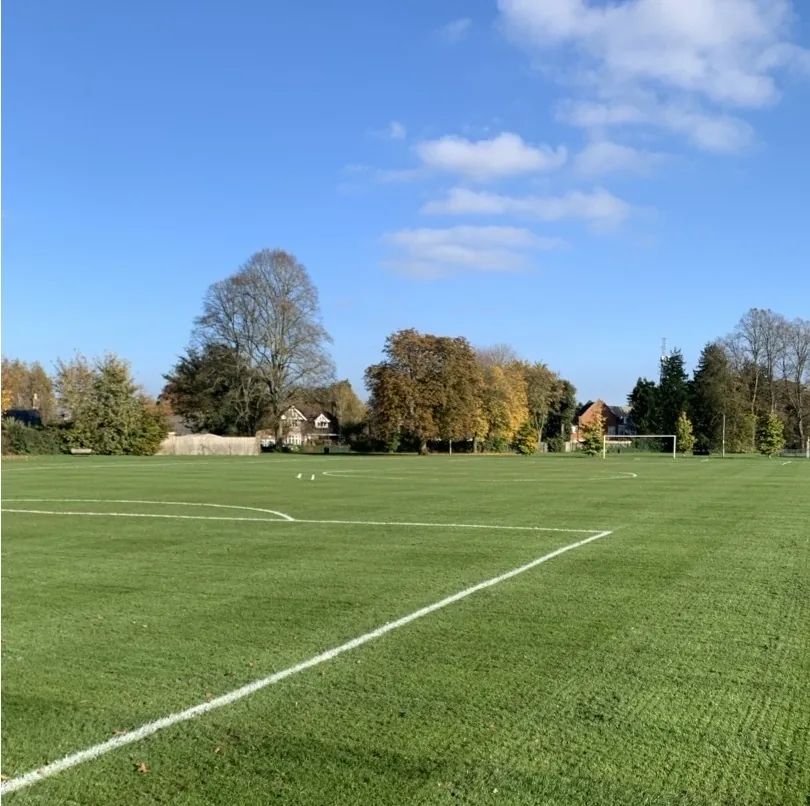
Corners and optional marks
A corner arc with a radius of 1 m is drawn inside the pitch at each corner, centred on a corner flagpost. The flagpost must be at least 1.5 m high with a flag and a non-pointed top. For a corner kick the ball must be placed in the arc, and it may touch the lines.
Law 1 also allows two kinds of optional marking:
- Marks off the pitch, 9.15 m from the corner arc, at right angles to the goal line and touchline. They help the referee keep defenders back at corner kicks.
- Halfway line flagposts, one at each end of the halfway line, at least 1 m outside the touchline.
Where there is a technical area for each team's coaches and substitutes, it is marked too, extending up to 1 m beyond each side of the bench and up to 1 m from the touchline.
No other football markings. Only the lines in Law 1 may be marked for the match. Referees can use vanishing spray for free kicks, but that disappears within a minute or two.
How the lines work in play
The lines belong to the areas they enclose. For a ball to be out of play, the whole of the ball has to cross the whole of the line, on the ground or in the air. For a goal, the whole ball must cross the goal line between the posts and under the crossbar. A ball touching any part of the line is still in.
The same principle applies to the boxes. A defender's handball or foul on the penalty area line is inside the area, so it is a penalty. A goalkeeper can also handle a ball that is on the penalty area line.
Coloured lines on 3G pitches
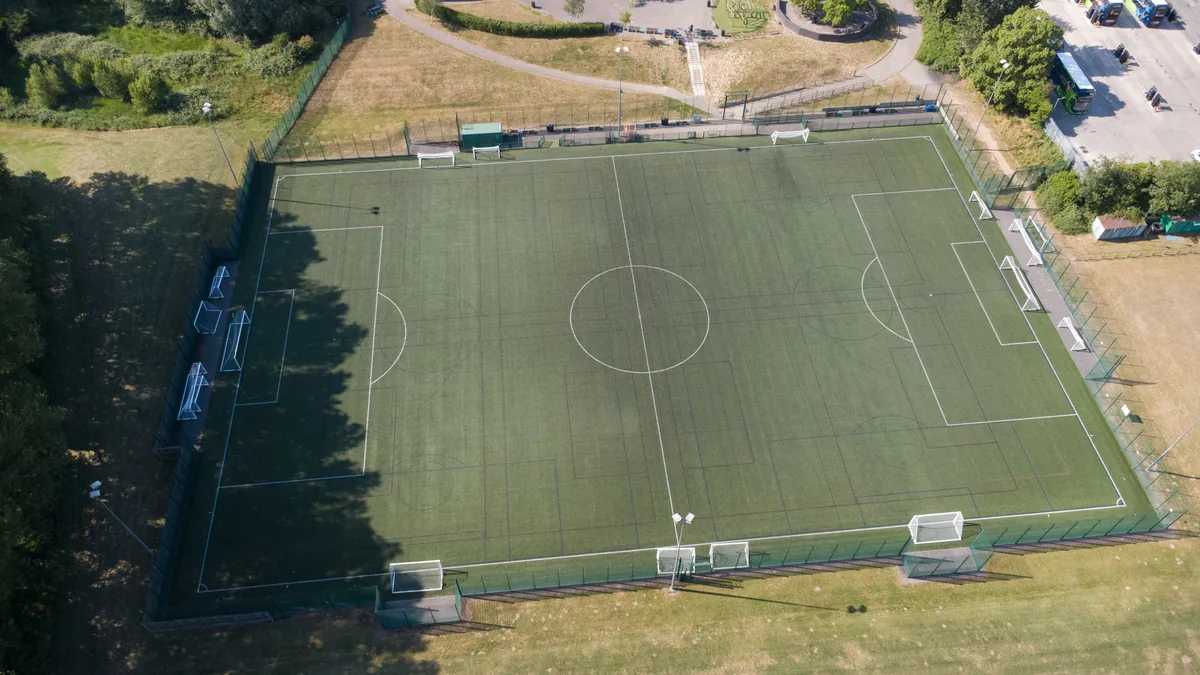
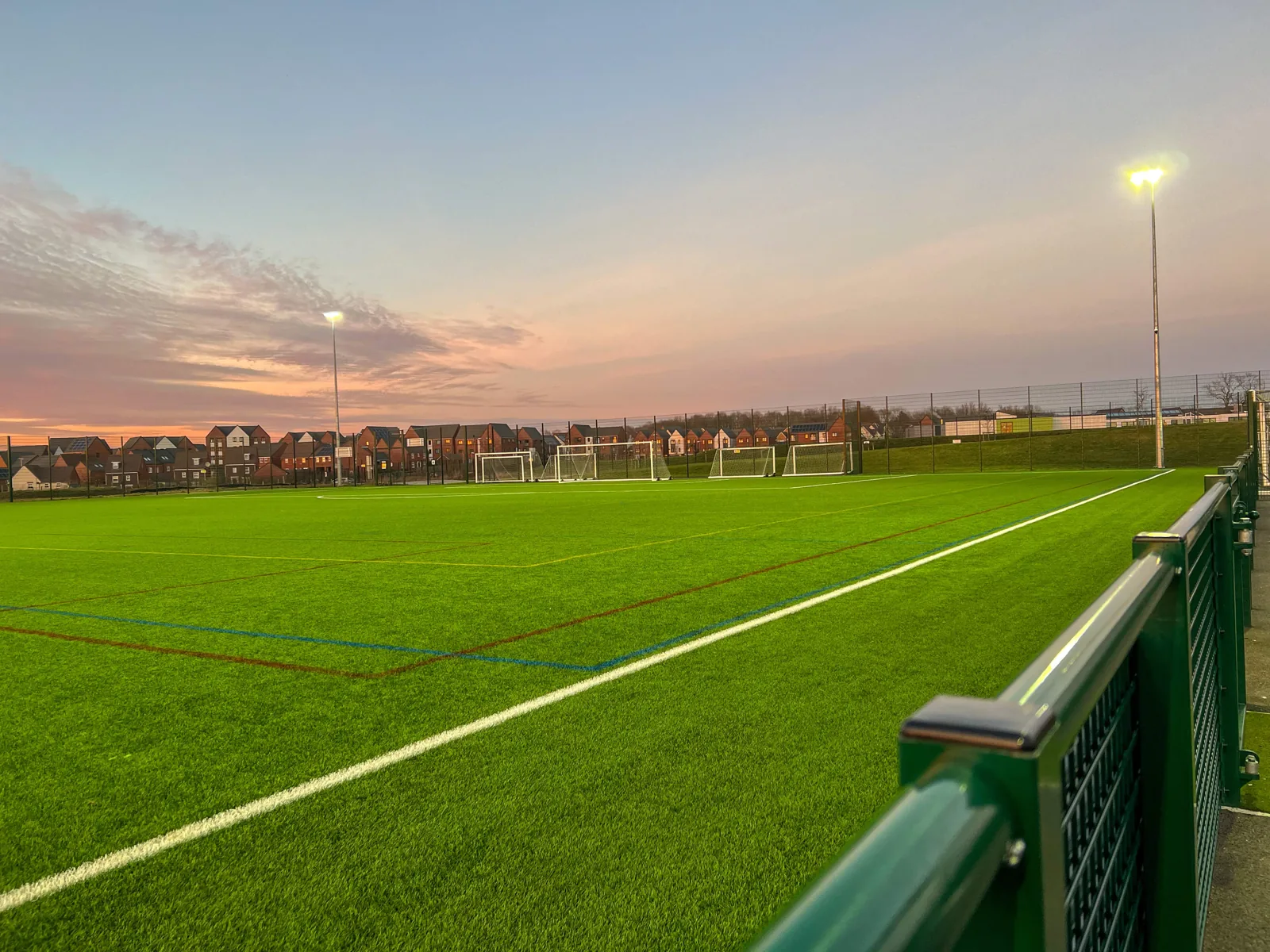
Full-size artificial pitches are often marked for several formats at once, so one surface can host 11-a-side, two 7-a-side games or three 5-a-side games. The FA says the 11v11 adult pitch on a 3G must be marked in white. Other lines are allowed if they are a different colour and clearly distinguishable. The FA's suggested colours:
| Colour | Format |
|---|---|
| Red | 5v5, under-8 and under-9 from 2026-27 |
| Yellow | 7v7, under-10 and under-11 |
| Blue | 9v9, under-12 and under-13 |
| White | Older age groups and adults (11v11) |
Many venues follow this, though some use their own colours, and hockey lines on shared astro pitches add more. When you book a third or a half of a big pitch, ask which colour marks your area. Our guides to 7-a-side and 9-a-side pitch sizes explain how the smaller pitches sit on a full-size one.
Cities with the most artificial grass pitches in our directory:
FAQ
How wide are the lines on a football pitch?
No more than 12 cm, or 5 inches, and all lines on the pitch must be the same width.
Is the ball out if it is on the line?
No. The whole of the ball must cross the whole of the line before it is out of play or a goal is scored.
What is the D on a football pitch for?
The penalty arc keeps players other than the kicker and goalkeeper at least 9.15 m from the penalty mark when a penalty is taken.
Why are there yellow and blue lines on 3G pitches?
They mark smaller pitches for youth formats. The FA suggests yellow for 7v7, blue for 9v9 and red for 5v5, with the adult pitch in white.