The centre circle and halfway line
 By the Find My Football Pitch team·
Updated ·
5 min read
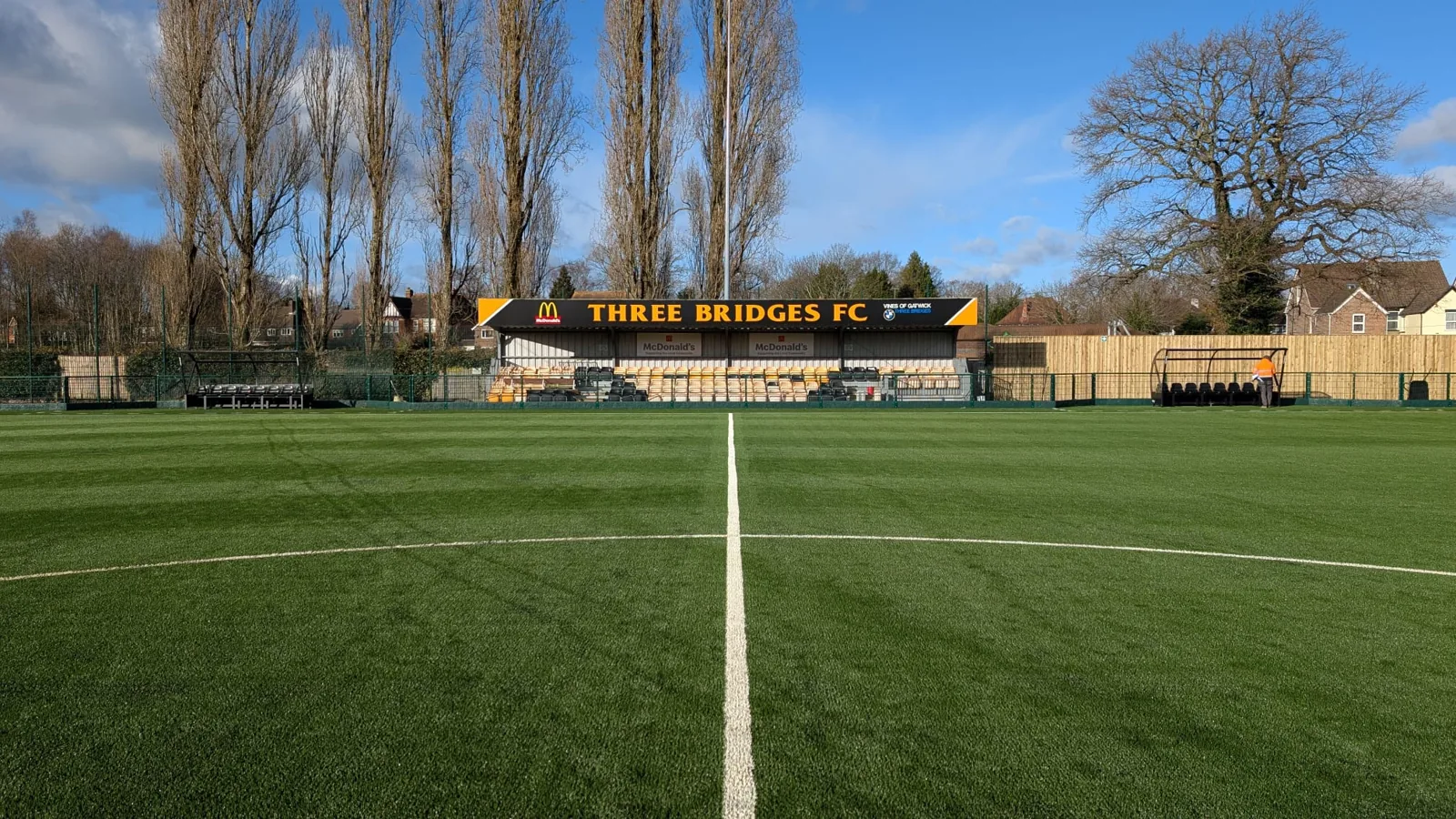
The middle of the pitch has the simplest markings: one line, one circle and a spot. They matter at the start of each half, after every goal, and for offside.
The short answer
The centre circle has a radius of 9.15 m (10 yards), drawn round the centre mark in the middle of the halfway line. Its diameter is 18.3 m. At kick-off, players of the team not kicking off must stay outside it until the ball is in play, and all players must be in their own half. The halfway line divides the pitch in two, and no player can be offside in their own half.
Size of the centre circle
Law 1 of the Laws of the Game sets the centre circle at a radius of 9.15 m, or 10 yards, measured from the centre mark. Like all lines it can be up to 12 cm wide, and the measurement is taken to the outside of the line.
| Measurement | Metres | Yards |
|---|---|---|
| Radius | 9.15 m | 10 yd |
| Diameter | 18.3 m | 20 yd |
| Circumference | about 57.5 m | about 63 yd |
| Area | about 263 m² | about 314 sq yd |
The radius is the same 9.15 m that turns up across the Laws: the distance opponents must keep at free kicks and corner kicks, and the radius of the penalty arc. That makes the centre circle a useful reference. If you want to judge 10 yards in a match, the circle shows you what it looks like.
The centre circle is the same size on every full-size pitch, from the smallest legal pitch to a Premier League stadium. Youth and small-sided pitches use smaller circles, set by the national association or the venue.
The halfway line
The halfway line joins the midpoints of the two touchlines and splits the field of play into two equal halves. The centre mark, a spot in the middle of the line, is where the ball is placed for every kick-off.
Law 1 allows an optional flagpost at each end of the halfway line, at least 1 m outside the touchline. You see them at some stadiums, but most grassroots pitches do without.
For offside, the halfway line itself does not count as the opponents' half. A player is only in an offside position if part of their head, body or feet is beyond it.
The kick-off
A kick-off starts each half, each half of extra time, and play after a goal. Law 8 says:
- All players except the kicker must be in their own half.
- Players of the team not kicking off must be at least 9.15 m from the ball until it is in play, which in practice means outside the centre circle.
- The ball must be stationary on the centre mark.
- The ball is in play once it is kicked and clearly moves. It can go in any direction, including backwards.
- The kicker cannot touch the ball again until another player has touched it.
A goal can be scored directly from a kick-off against the opponents. If the ball goes straight into the kicker's own goal, the opponents get a corner kick instead.
The team that wins the toss chooses which goal to attack in the first half, or to take the first kick-off. On a sloping pitch, or with a strong wind, that choice matters. See pitch slope.

The halfway line and offside
You cannot be in an offside position in your own half. That is the halfway line's main job once the game is running. A forward standing on the halfway line when a pass is played, with any part of the head, body or feet in the opponents' half, can be offside if the other offside conditions are met. Arms and hands do not count when judging offside position, for attackers or defenders.
This is why defenders push up to the halfway line when their team attacks: forwards who stay in the opponents' half while the ball is in the other half can be caught offside when the ball is played forward. The full rule is in our offside rule guide.
Offside in your own half. A quick way to remember it: if the player receiving the pass was in their own half when the ball was played, they cannot be offside, wherever they end up.
Other uses of the middle of the pitch
- Penalty shoot-outs. During kicks from the penalty mark, all players except the kicker and the two goalkeepers wait inside the centre circle.
- Ceremonies and coin tosses. Captains meet the referee at the centre mark for the toss.
- Small-sided pitches. On 5-a-side pitches the centre circle is smaller and kick-offs often follow the venue's own rules. See 5-a-side pitch size.
For the other markings, see football pitch markings explained and the penalty area and six-yard box. Every official measurement is in football pitch dimensions.
FAQ
How big is the centre circle?
It has a radius of 9.15 m, or 10 yards, and a diameter of 18.3 m.
Can you score directly from a kick-off?
Yes, against the opponents. A kick-off that goes straight into your own goal gives the opponents a corner kick.
Can the kick-off go backwards?
Yes. Since 2016 the ball only has to be kicked and clearly move, in any direction.
Can you be offside on the halfway line?
Yes, if any part of your head, body or feet is past the halfway line into the other half when the ball is played. If you are fully in your own half, you cannot be offside.