Can a football pitch be on a slope?
 By the Find My Football Pitch team·
Updated ·
5 min read
Plenty of park pitches in Britain and Ireland run downhill, and every Sunday league player knows which end they would rather attack. The Laws of the Game say nothing about slope, but pitch builders and governing bodies do have guidance. Here is how much slope is normal, how much is too much, and how it changes a game.
The short answer
Yes, a football pitch can be on a slope. The Laws of the Game set the size and markings of a pitch but give no limit on gradient, so a sloping pitch is still legal for most matches. Pitch builders aim for a near-flat surface with a gentle fall for drainage. Sportscotland's guidance, for example, is flat to 1 in 100 along the length and 1 in 80 to 1 in 50 across the width, sloping one way only. Higher leagues may add their own ground rules.
What the Laws say
Law 1 of the IFAB Laws of the Game covers the field of play. It sets the length and width ranges, the markings, the goal size and the surface, which must be wholly natural or, where competition rules allow, wholly artificial. It does not set a maximum gradient or say the pitch must be level.
So a referee will not abandon a match because a pitch slopes. Referees do check that the pitch is safe and properly marked, and leagues can set their own ground criteria. In England, clubs in the National League System are graded on their grounds, and step-up rules can force a club to improve its pitch before it is promoted. If your club is moving up, check the ground grading document for your level.
For the size and markings the Laws do set, see our guide to football pitch dimensions.
How flat a pitch should be
Guidance for new natural grass pitches in the UK gives target gradients. Sportscotland's natural turf datasheet sets out:
| Direction | Target | Acceptable range |
|---|---|---|
| Along the length | Flat | Flat to 1 in 100 |
| Across the width | 1 in 80 | 1 in 80 to 1 in 50 |
The slope should fall in one direction only, so water runs off one side rather than pooling in the middle.
To picture the numbers on a 100 by 64 m pitch:
- 1 in 100 along the length means one goal line is up to 1 m higher than the other.
- 1 in 80 across the width means one touchline is 0.8 m higher than the other.
- 1 in 50 across means a difference of about 1.3 m from side to side.
At these gradients you barely notice the slope when playing. Many older park and village pitches are far steeper, because they were laid on the land as it was rather than graded. Bringing one into the guidance range can mean stripping the topsoil, regrading the subsoil and putting the topsoil back, which is a big earthworks job.
Artificial pitches are flatter. 3G and other artificial pitches are built on an engineered base and are laid close to flat, with only a very slight fall for drainage. If you are tired of playing uphill, a 3G is the answer. See how artificial pitches are built.
Why pitches are built with a slight slope
A perfectly flat grass pitch holds water. Rain soaks in until the soil is saturated, then sits on the surface. A gentle cross fall lets surface water run to the side, where drains or ditches carry it away. That is why the guidance prefers the slope across the width rather than along it. A slope along the length would send water towards one goalmouth, which is already the most worn part of the pitch.
Drainage is the main cause of postponed grassroots matches, so even a little fall helps. Our guide to waterlogged pitches explains what else groundstaff do.
How a slope changes the game
On a pitch with a noticeable fall from end to end:
- Long balls run on downhill and die going uphill. Passes into the channels travel faster than you expect.
- Attacking uphill is tiring. Pressing high up a slope wears players out quickly, so many teams sit deeper when going uphill.
- Goalkeepers struggle with shots and crosses coming down the slope, which skid and pick up pace on wet grass.
- The coin toss matters. Under Law 8, the team that wins the toss chooses which goal to attack in the first half or takes the kick-off. Many captains choose to play uphill first, while legs are fresh, and finish with the slope in their favour.
A cross slope is less obvious but still shows. The ball drifts towards the low touchline, and wingers on the low side get more of the ball.
Famous sloping pitches
The best-known example in English football is Yeovil Town's old Huish ground, which was famous for a side-to-side slope of about 8 feet (2.4 m). The club left it for Huish Park in 1990. Many non-league and amateur grounds still have a visible fall, and in hilly areas a flat site is often the exception.
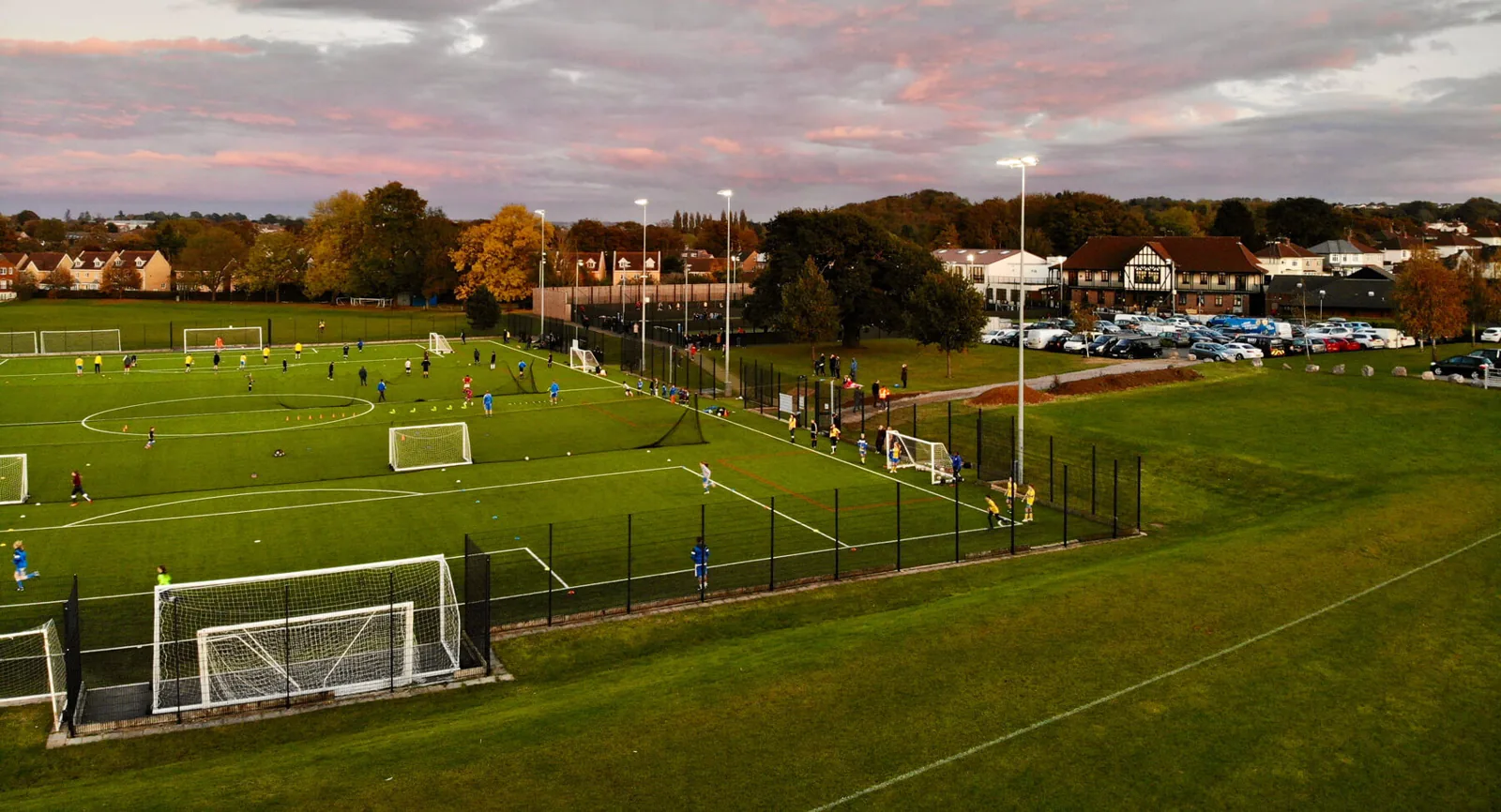
Imperial Sports Ground
Bristol · 4G and grass
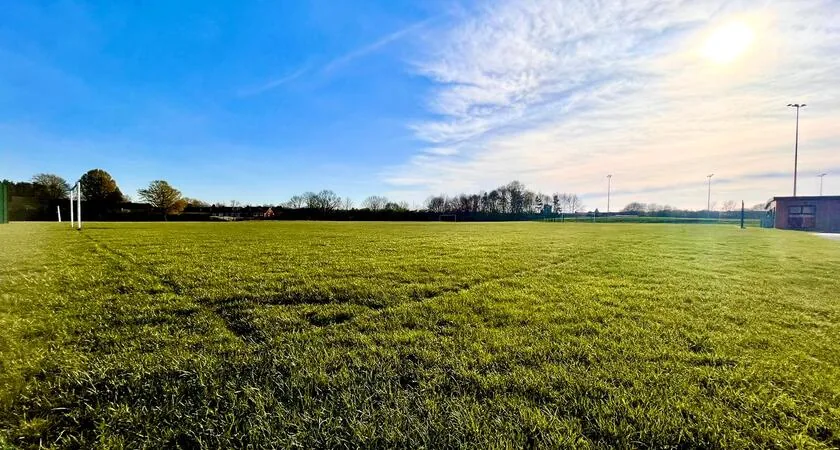
Lyng Hall School
Coventry · Grass 11-a-side
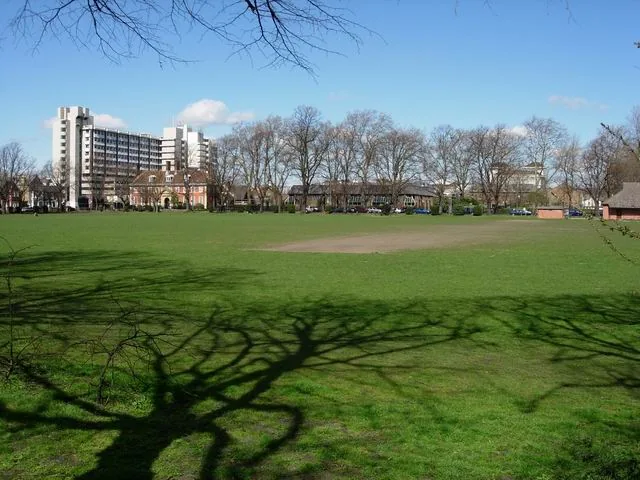
Fairfield Recreation Ground
London · Park grass pitches
FAQ
Is there a maximum slope for a football pitch?
The Laws of the Game set no maximum. Construction guidance for new grass pitches aims for flat to 1 in 100 along the length and 1 in 80 to 1 in 50 across the width.
Should you play uphill or downhill first?
Many captains play uphill in the first half while players are fresh and use the slope in the second half. The team that wins the toss chooses which goal to attack first.
Why is my local pitch higher on one side?
Pitches are often built with a gentle fall from one touchline to the other so rain runs off. On older park pitches the slope may simply follow the land.
Can a sloping pitch be levelled?
Yes, but it usually means stripping the topsoil, regrading the ground underneath and replacing the topsoil, followed by a season for the grass to settle.