The penalty area, six-yard box and penalty spot
 By the Find My Football Pitch team·
Updated ·
5 min read
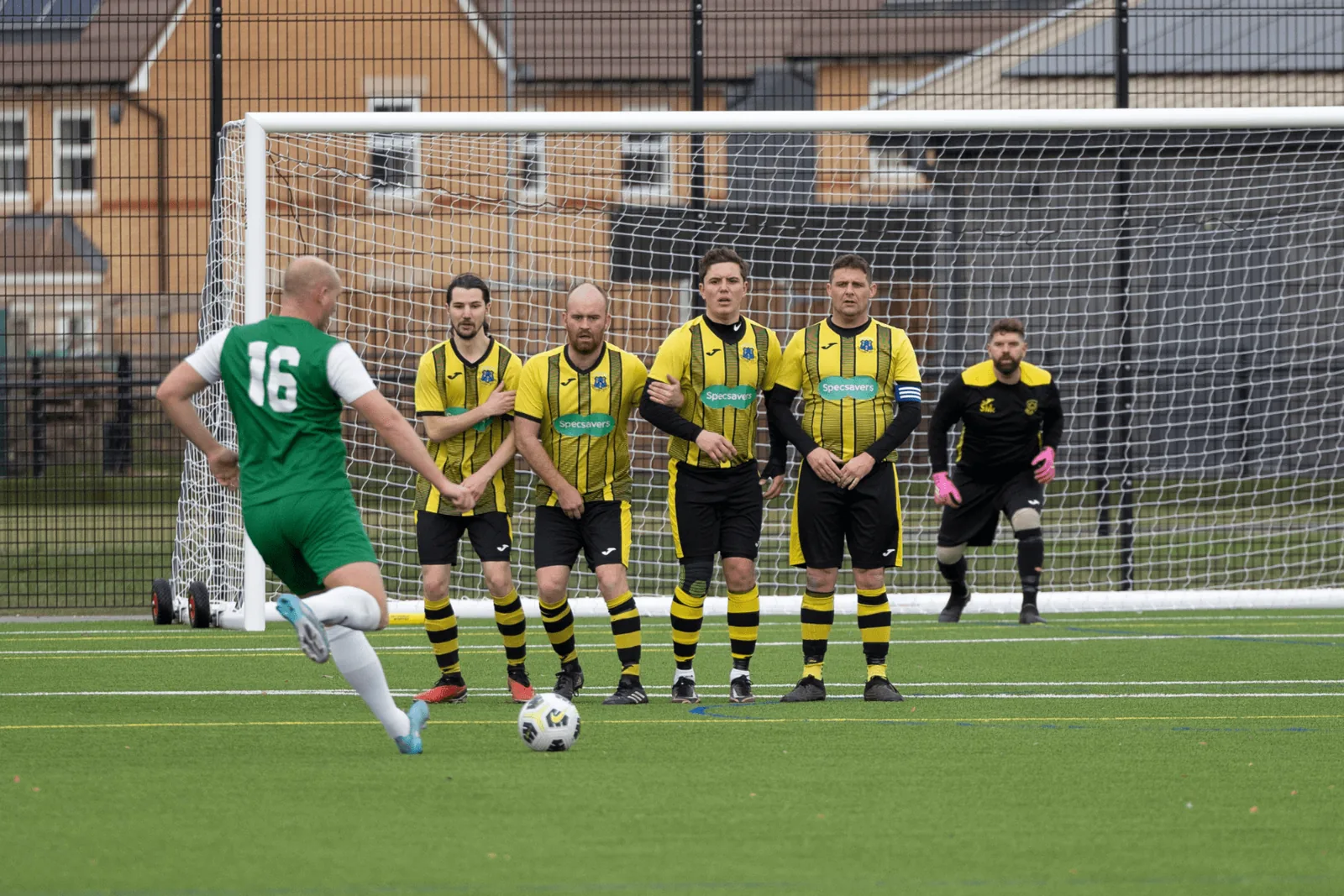
The two boxes and the spot in front of each goal decide more matches than any other markings on the pitch. Their sizes are fixed by the Laws of the Game, and they are the same on every full-size pitch, whatever its length and width.
The short answer
The penalty area extends 16.5 m (18 yards) from the inside of each goalpost and 16.5 m into the pitch, so it is 40.32 m wide and 16.5 m deep. The goal area, or six-yard box, extends 5.5 m (6 yards) from each post and 5.5 m out, making it 18.32 m wide. The penalty spot is 11 m (12 yards) from the middle of the goal line, and the penalty arc has a radius of 9.15 m (10 yards) from the spot.
Sizes at a glance
| Marking | Metres | Yards |
|---|---|---|
| Penalty area depth | 16.5 m | 18 yd |
| Penalty area width | 40.32 m | 44 yd |
| Goal area depth | 5.5 m | 6 yd |
| Goal area width | 18.32 m | 20 yd |
| Penalty mark, from the goal line | 11 m | 12 yd |
| Penalty arc radius | 9.15 m | 10 yd |
| Goal, inside the posts | 7.32 m wide, 2.44 m high | 8 yd wide, 8 ft high |
All of these come from Law 1 of the Laws of the Game. Like every other line, the box lines can be up to 12 cm wide, and distances are measured to the outside of the lines. The widths follow from the goal: 7.32 m between the posts, plus 16.5 m on each side for the penalty area or 5.5 m on each side for the goal area.
The penalty area
The penalty area, the 18-yard box or just "the box", is the bigger rectangle in front of each goal. It does three main jobs:
- Goalkeeper handling. The goalkeeper may handle the ball only inside their own penalty area. Outside it they are treated like any other player.
- Penalty kicks. If a defender commits a direct free kick offence, such as a trip, a push or a handball, inside their own penalty area while the ball is in play, the attacking team gets a penalty instead of a free kick.
- Restarts. At a goal kick, opponents must stay outside the penalty area until the ball is in play. The same applies when the defending team takes a free kick inside its own area.
Because the line is part of the area, a foul on the line of the box is a penalty. What matters is where the offence happens, not where the player falls.
The rectangle with these dimensions has been on pitches since 1902. Before that the penalty zone was marked differently, and the penalty kick itself dates from 1891.
The goal area or six-yard box
The goal area is the small rectangle directly in front of the goal. Most of its jobs are about where the ball goes for a restart:
- Goal kicks can be taken from any point inside the goal area. The ball is in play once it is kicked and clearly moves; it no longer has to leave the penalty area first.
- Defending free kicks awarded inside the goal area can be taken from anywhere in it.
- Attacking indirect free kicks for an offence inside the goal area are moved out to the goal area line parallel to the goal line, at the point nearest to where the offence happened.
- Dropped balls in the penalty area go to the defending goalkeeper.
Goalkeepers do not get special protection inside the six-yard box under the Laws. Referees judge challenges on goalkeepers the same way anywhere, though crowded goalmouths at corners are where many of those decisions happen.
The penalty spot and arc
The penalty mark is 11 m from the midpoint between the goalposts. For a penalty kick:
- The ball must be still on the penalty mark, and the posts, crossbar and net must not be moving.
- The goalkeeper stays on the goal line between the posts, facing the kicker, without touching the posts, crossbar or net. When the ball is kicked, at least part of one foot must be touching, or in line with, the goal line.
- Every other player must be on the pitch, outside the penalty area, behind the penalty mark and at least 9.15 m from it.
- The kicker must kick the ball forward.
That 9.15 m is the reason for the arc on the edge of the box, sometimes called the D. Parts of the pitch outside the penalty area but still within 9.15 m of the spot would otherwise be allowed, so the arc marks the area players must keep out of. The arc is not part of the penalty area, and the goalkeeper cannot handle the ball inside it.
Re-marking the spot. On grass pitches the penalty spot wears badly, because it is one of the most-trodden parts of the pitch. Ground staff measure it from the middle of the goal line, not from the edge of the penalty area, to keep it at exactly 11 m.
Boxes on smaller pitches
Youth and small-sided pitches use smaller areas. The Laws let competitions change the size of the pitch and goals for under-16s, veterans, disability football and women's football, and national associations publish their own layouts for each format. On the FA's youth pitches the penalty area and spot shrink with the pitch. On adult 5-a-side pitches there is often a semicircular goalkeeper area instead of a rectangular box, and outfield players may not be allowed in it at all.
For those layouts, see 5-a-side pitch size, 7-a-side pitch size and 9-a-side pitch size. The rest of the full-size markings are covered in football pitch markings explained, and the goal sizes for each format in football goal sizes.
FAQ
How big is the penalty box?
The penalty area is 16.5 m (18 yards) deep and 40.32 m (44 yards) wide on every full-size pitch.
How far is the penalty spot from the goal?
11 metres, or 12 yards, measured from the midpoint between the goalposts.
Why is it called the six-yard box?
The goal area extends 6 yards, or 5.5 metres, from each post and 6 yards into the pitch.
Is the D part of the penalty area?
No. The penalty arc only marks a 9.15 m distance from the spot that players must keep at a penalty kick. A foul inside the D is a free kick, not a penalty.