A 10-minute warm-up before football
 By the Find My Football Pitch team·
Updated ·
5 min read
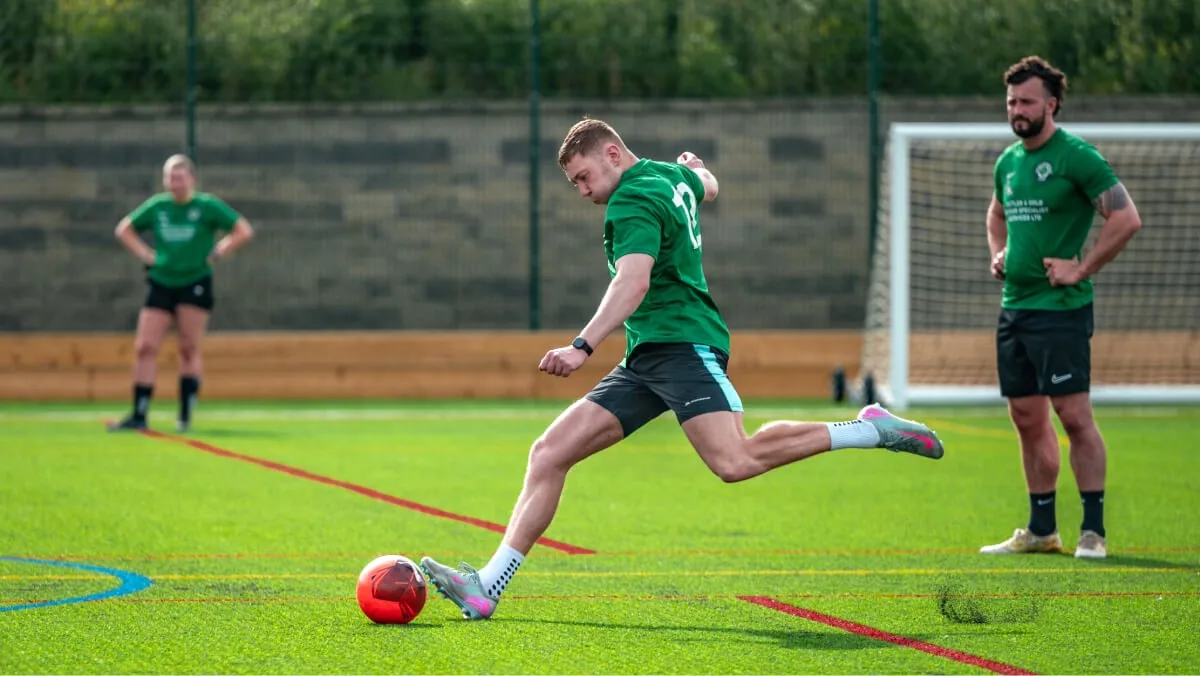
Most 5-a-side games start with two people taking shots at an empty goal while everyone else ties their laces. A proper warm-up takes ten minutes and is one of the few things proven to cut football injuries.
The short answer
A good football warm-up raises your heart rate, then works the muscles and joints you use in a game: hamstrings, groin, calves, ankles and knees. Spend about 10 minutes on easy jogging, running drills, a few strength and balance moves, then short sprints and passing. The FIFA 11+, a 20-minute programme in three parts, cut injuries by about 30% in a meta-analysis of trials. The 10-minute routine below borrows its main ideas for players who only have the time before kick-off.
Why warming up works
A warm-up does three jobs. It gets blood to your muscles so they are warmer and more elastic. It puts your joints through the movements of the game before you do them at full speed. And it switches on balance and landing control, so your knees and ankles are better protected when you turn or get bumped.
The evidence is better than for most sports advice. In a 2008 trial published in the BMJ, Norwegian clubs with 1,892 female players aged 13 to 17 were split into two groups. Teams that used a structured warm-up had fewer injuries overall (rate ratio 0.68), fewer overuse injuries (0.47) and fewer severe injuries (0.55) over a season. A 2017 meta-analysis of six randomised trials, covering 6,344 players, found that the FIFA 11+ reduced the risk of injury by 30%.
Stretching on its own, holding a calf stretch for 30 seconds, is not what those trials tested. The benefit comes from movement, strength and balance work.
The FIFA 11+ in brief
The FIFA 11+ was developed by FIFA's medical research team together with injury researchers. It has 15 exercises in a set order, takes about 20 minutes, and is meant to replace a team's normal warm-up at least twice a week.
- Part 1: running exercises (about 8 minutes). Jogging with hip in and hip out, circling a partner, shoulder contact, and quick forward and backward runs.
- Part 2: strength, plyometrics and balance (about 10 minutes). Planks, side planks, Nordic hamstring lowers, single-leg balance, squats and jumps. Each exercise has three levels of difficulty.
- Part 3: running exercises (about 2 minutes). Running across the pitch at speed, bounding, and plant-and-cut changes of direction.
If you coach a team that trains twice a week, use the full programme. FIFA publishes the exercises with videos and posters, free.
A 10-minute warm-up
For a 5-a-side or casual game where you have ten minutes on the pitch before kick-off, this cut-down routine keeps the parts that matter. Use half the pitch width as your running lane.
| Time | What to do |
|---|---|
| 0 to 2 min | Easy jog there and back. Add hip out (lift your knee and open it to the side) and hip in on the way back. |
| 2 to 4 min | Side shuffles, backward jogging, high knees, heel flicks. One lane each. |
| 4 to 6 min | Ten squats, ten walking lunges, a 30-second plank and 20 seconds of side plank on each side. |
| 6 to 7 min | Balance on one leg for 30 seconds each, passing a ball with a partner if you have one. Then five small jumps forward, landing softly with knees over toes. |
| 7 to 9 min | Passing in pairs, getting quicker. Finish with five short, sharp changes of direction each. |
| 9 to 10 min | Three runs at 70%, 80% and 90% of full speed over 15 to 20 metres. Walk back. |
Then start the game. If you start with five minutes in goal, use them to keep moving.
Older players and anyone returning after a break: a cold hamstring or calf is easy to pull in the first sprint. Do not skip the three build-up runs at the end, and take the first few minutes of the game at three-quarter pace.
Cold weather and late arrivals
On a cold evening, muscles take longer to warm up. Keep your tracksuit or a long-sleeved layer on until the end of the routine, and add a couple of extra minutes of jogging. Our guide to playing football in rain and cold covers kit for winter.
If you arrive late, do a short version rather than none: one minute of jogging, the hip in and hip out, ten squats and three build-up runs. Even three minutes is better than starting cold.
Booked slots often start the moment the previous group leaves. Warm up beside the pitch or in the car park while you wait, so you do not lose playing time.
After the game
A cool-down matters less for injury risk, but a few minutes of walking and some gentle stretches for your calves, hamstrings, thighs and hips help you feel less stiff the next day. Drink water before you head to the bar.
Warming up is one part of staying fit enough to keep playing. Read injuries on artificial grass for the other part, which is the right boots for the surface.

FAQ
How long should a football warm-up be?
About 10 minutes for a casual game and up to 20 minutes for a team using the full FIFA 11+. Longer warm-ups add little for a one-hour 5-a-side game.
Should you stretch before football?
Moving stretches such as hip in and hip out, leg swings and lunges are better before a game than long static stretches. Save the held stretches for after.
Is the FIFA 11+ only for professionals?
No. It was designed for amateur teams, and the 2008 Norwegian trial behind it was done with youth club players aged 13 to 17.
Do goalkeepers need a different warm-up?
Goalkeepers should do the same running and strength work, then add catching, diving and kicking practice at increasing pace before the game.