Are you more likely to get injured on artificial grass?
 By the Find My Football Pitch team·
Updated ·
5 min read
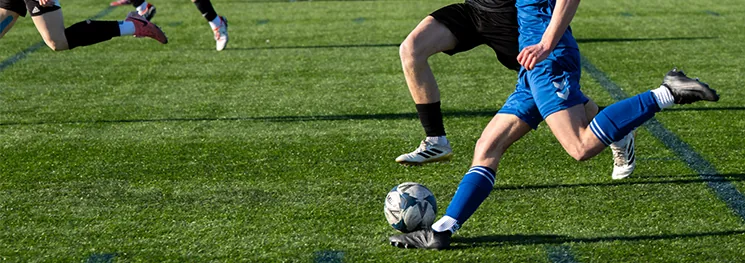
Ask a Sunday league team about 3G and someone will blame it for their knee. The research tells a calmer story. Modern artificial grass is not more dangerous overall, but it does change which injuries you are likely to pick up.
The short answer
No, not overall. A 2023 meta-analysis of 22 studies found football injuries were slightly less common on artificial turf than on grass, with the clearest difference in professional players and no clear difference for amateurs. Knee injuries were also lower on turf. Another 2023 review found more foot and ankle injuries on artificial surfaces. The one injury that is clearly worse on artificial grass is skin abrasion, often called turf burn. Older, thin "astro" behaves differently from modern 3G.
What the research says
The biggest recent study is a systematic review and meta-analysis by Kuitunen and colleagues, published in eClinicalMedicine in 2023. It pooled cohort studies that compared football injuries on artificial turf with grass. The main findings:
- All injuries: about 14% fewer injuries on artificial turf than on grass (incidence rate ratio 0.86).
- Professional players: about 21% fewer on turf (rate ratio 0.79).
- Amateur players: no clear difference either way (rate ratio 0.91, with a confidence interval running from 0.77 to 1.09).
- Knee injuries: lower on turf (rate ratio 0.77).
The authors concluded that injury risk should not be used as an argument against artificial turf. They also flagged a weakness: only a few of the studies adjusted for other factors, such as weather, fixture congestion or the quality of each surface. The studies were observational, so they show patterns rather than proof.
A second 2023 review, by Gould and colleagues in the American Journal of Sports Medicine, looked at lower-limb injuries and did not pool the numbers because the studies differed too much. Most of the studies it covered found higher rates of foot and ankle injuries on artificial turf, on both older and newer surfaces. For soccer players on modern turf, knee injury rates were similar on both surfaces, and hip injury rates were similar too. The higher knee risk it flagged was for elite American football players, not soccer.
Put together: for a typical amateur player, the surface makes little difference to your overall chance of getting hurt. What you wear on your feet, how well you warm up and how fit you are matter more.
Injuries that differ between surfaces
| Injury | What the evidence suggests |
|---|---|
| Overall injuries | Similar or slightly lower on modern artificial turf |
| Knee injuries | Lower on turf in the pooled data; similar on both surfaces for soccer in the other review |
| Foot and ankle injuries | Higher on artificial turf in most studies covered by one 2023 review |
| Skin abrasions | More common on artificial surfaces, a pattern every regular player knows |
Skin abrasions are the obvious one. Fall or slide on grass and you get a grass stain. Do it on artificial grass and the friction takes a layer of skin off. Our guide to turf burn covers treatment and how to avoid it.
Why players blame 3G
If the overall numbers are similar, why does 3G have such a bad name?
- Older surfaces were worse. Early artificial pitches were short, hard and sand-filled. Many of the horror stories come from those. Modern 3G has longer fibres and rubber or organic infill. See what a 3G pitch is and what astroturf is.
- Grip. Artificial grass grips boots more evenly than grass. Long studs that would slip on wet grass can lock into 3G, which loads the ankle and knee when you twist.
- Worn pitches. A 3G pitch with compacted, missing infill gets hard and slippery. That is a maintenance problem, not a surface problem. Read how long a 3G pitch lasts.
- Sore legs. Many players say their legs and joints ache more after 3G. That feeling is common, though the injury studies have not shown a matching rise in injuries.

How to cut your risk on 3G
- Wear the right boots. Artificial ground (AG) boots have more, shorter studs designed for 3G. Firm ground boots with long blades grip too much. On old sand-based astro, use turf trainers. Our guide to boots for 3G explains which to buy.
- Warm up properly. Structured warm-ups such as the FIFA 11+ reduce injuries in trials. A ten-minute version is in our football warm-up guide.
- Cover your skin. Long socks, sliding shorts or leggings and a long-sleeved top cut grazes.
- Avoid slide tackles. Many 5-a-side leagues ban them anyway.
- Check the pitch. If the infill is thin, the surface is hard or the carpet has bare patches, play with care and tell the venue.
If you keep getting the same ankle or knee problem, or you cannot put weight on a joint after a twist, get it checked by a GP or physio.

Cities with the most artificial grass pitches in our directory:
FAQ
Is 3G bad for your knees?
The pooled evidence shows fewer knee injuries on artificial turf than on grass overall. Another review found similar knee injury rates on modern turf and grass for soccer players. For most amateurs, the right boots matter more than the surface.
Are ACL injuries more common on artificial grass?
The two big reviews did not give a clear answer for this specific injury. Long-studded boots that lock into the surface are a known concern, which is why AG boots are recommended on 3G.
Is 3G safer than astroturf?
Modern 3G with longer fibres and rubber or organic infill is generally softer and closer to grass than old, short-pile sand-based astro. Sand-based pitches cause more grazes.
Do pros prefer grass?
Many professional players say they prefer grass, partly because of how the ball rolls and how their legs feel afterwards. The injury data for professionals actually shows slightly fewer injuries on turf.