What is a hybrid pitch?
 By the Find My Football Pitch team·
Updated ·
4 min read
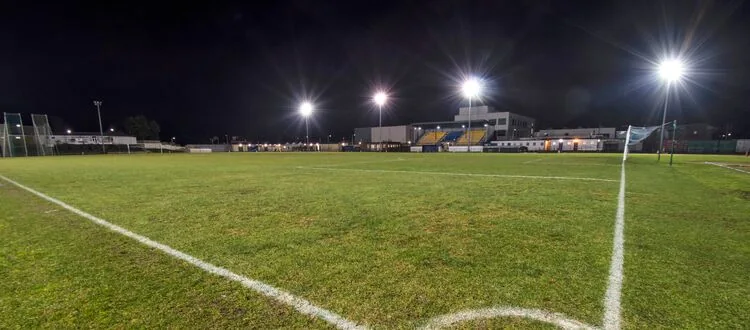
Commentators say a stadium has a "hybrid pitch" and it looks like any other grass pitch on television. The difference is under the surface, where millions of plastic fibres hold the real grass together.
The short answer
A hybrid pitch is natural grass reinforced with a small share of synthetic fibres. The most common type is stitched: a machine injects artificial fibres about 20 cm deep into the rootzone in a tight grid, and the grass roots wrap around them. The plastic is only a few per cent of the surface, so it plays and looks like grass but tears less, recovers faster and can take more matches. Many top-flight stadiums now use one. The Laws of the Game allow hybrid surfaces where competition rules permit.
What a hybrid pitch is
A natural grass pitch fails where players turn, stop and slide. The roots tear, the turf lifts as a divot and the soil underneath compacts. Groundstaff can repair it, but in a busy season the goalmouths and centre circle wear to bare earth.
A hybrid pitch adds plastic to hold the turf together. The synthetic fibres are anchored deep in the sand-based rootzone and stick up a short way above it. Grass grows around them, and its roots tangle with the fibres. When a player plants a foot, the load spreads through roots and fibres together, so the surface holds.
From the stand it is a grass pitch. It is mown, watered and fed like one, and the ball rolls on living grass. It is not an artificial 3G pitch with a bit of grass added.
The main types
| Type | How it works | Typical use |
|---|---|---|
| Stitched | Fibres injected vertically into the rootzone by a machine, in a grid a couple of centimetres apart | Stadiums, training grounds |
| Carpet-based | Grass grown through a synthetic carpet with an open backing, laid on a sand rootzone | Stadiums, some new builds |
| Reinforced rootzone | Short synthetic fibres or mesh mixed into the sand before the grass is sown | Training pitches, cheaper builds |
Stitched systems are the best known. UEFA describes the pitch at Paris Saint-Germain's Parc des Princes as a Desso GrassMaster surface containing 3% polypropylene fibres. Each fibre is 200 mm long, with 180 mm below the surface and 20 mm showing, and they are stitched every 2 cm.
Stitching a full stadium pitch is specialist machine work, so it is usually done in the off-season.
Why stadiums use them
- Stability. The surface holds under sharp turns, so there are fewer divots and less slipping.
- More use. A hybrid copes with more matches, concerts and rugby fixtures between renovations.
- Faster recovery. Damaged areas recover quickly because the fibres keep the shape while new grass grows in.
- Consistency. The pitch plays similarly from August to May, which matters to clubs and broadcasters.
- Rules. Many competitions do not allow fully artificial pitches, so a hybrid gives extra strength while staying "grass" for competition purposes.
What they do not do
A hybrid pitch is still grass, and grass needs the right conditions.
- It still needs light. Stadiums with tall stands and shade often use grow-light rigs on the pitch overnight.
- It still needs mowing, watering, feeding, aeration and an end-of-season renovation. See how football pitches are looked after.
- It can still freeze or waterlog if the drainage or undersoil heating is not up to the job.
- It costs more to build and renovate than a plain sand-based grass pitch, and the plastic has to be dealt with at the end of its life.
It also cannot be booked for 60 hours a week like a 3G pitch. For community football, the choice is usually between grass and 3G. Our guide to artificial grass vs real grass compares them.
Can you tell by looking? Rarely. Close up, after a heavy game, you may see short plastic tufts in a goalmouth where the grass has worn thin. Otherwise a hybrid looks exactly like a well-kept grass pitch.
Where you will find them
Most hybrid pitches are at professional stadiums and training grounds, including many grounds in the Premier League and Europe's other top leagues. Some rugby grounds use them too.
They are uncommon at community level because of the cost and the specialist upkeep. The pitches you book in our directory are almost all natural grass or artificial turf, and the listing says which. For the grasses used on both, see what grass is used on football pitches.
FAQ
Is a hybrid pitch artificial?
No. It is natural grass with a small share of synthetic fibres, a few per cent of the surface, anchored in the rootzone to strengthen it.
Do Premier League clubs use hybrid pitches?
Many do. Fully artificial pitches are not allowed in the Premier League, and hybrid surfaces give extra strength while counting as grass.
How deep are the fibres in a stitched hybrid?
In a typical stadium system, about 18 cm below the surface with about 2 cm showing, as at the Parc des Princes in Paris.
Are hybrid pitches allowed by the Laws of the Game?
Yes. Law 1 allows an integrated combination of artificial and natural materials where competition rules permit it.